

Most Indian businesses still treat their website's privacy policy and cookie banner as a checkbox exercise—something a developer added years ago and nobody has touched since. That approach no longer holds up. The Digital Personal Data Protection Act, 2023 is now a functioning law. The Ministry of Electronics and Information Technology notified the DPDP Rules on 13 November 2025, officially establishing the Data Protection Board of India and setting a phased enforcement timeline that runs through 13 May 2027, when the full substantive obligations come into force. Consent manager provisions kick in from November 2026. The compliance clock isn't ticking somewhere in the future—it started the moment that notification was published.
And the stakes are not small. The DPDP Act's penalty schedule allows the Board to impose fines of up to INR 250 crore for failing to implement reasonable security safeguards, and up to INR 200 crore for failing to notify a data breach within the prescribed window. For most businesses, that's not a cost of doing business—it's an existential risk.
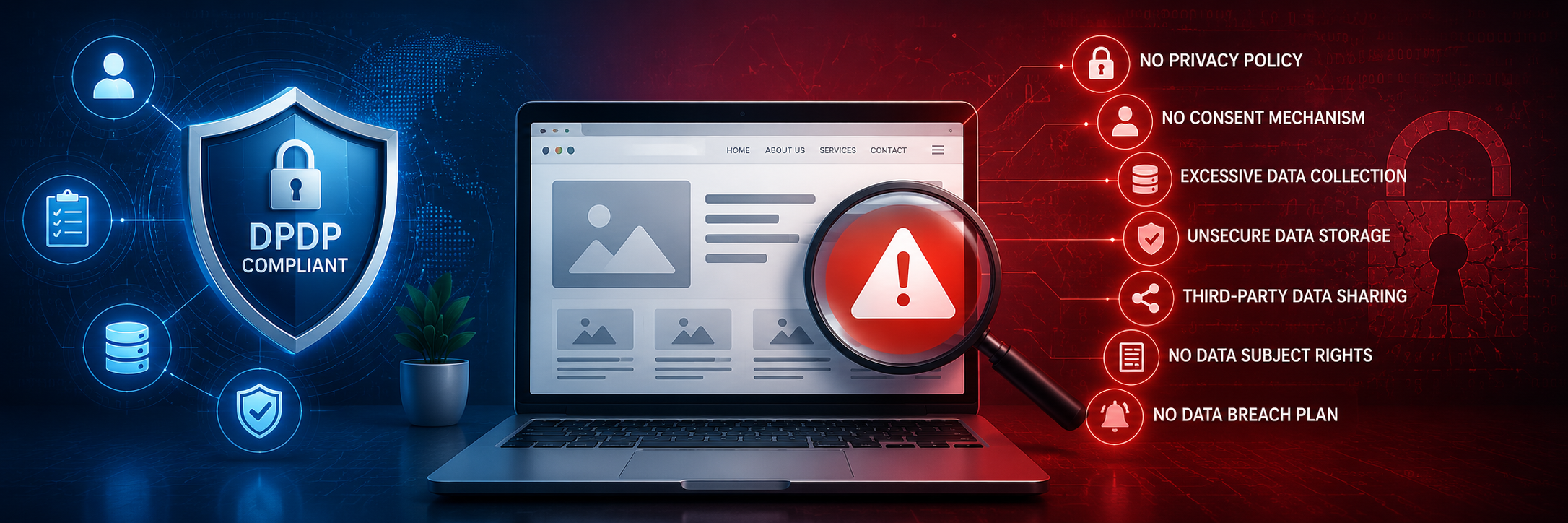
Yet most companies have no clear picture of where they actually stand. Compliance isn't something you either "have" or "don't have"—it shows up as small, easy-to-miss gaps scattered across your website's forms, cookies, and backend systems. Here are seven warning signs worth taking seriously.
1. Your Cookie Banner Is Just for Show
If your website's cookie banner only has an "Accept" button—or worse, cookies start firing before anyone clicks anything—that's not consent, it's a formality. Under the DPDP Act, consent must be free, specific, informed, and unambiguous, given through a clear affirmative action. A pre-ticked box or a banner with no real "reject" option doesn't meet that bar. If users can't easily decline non-essential tracking and still use your site, your consent mechanism is a liability, not a safeguard.
2. You Don't Know Where Your Data Actually Goes
Ask yourself honestly: do you know every third-party tool—analytics platforms, marketing pixels, chatbots, payment processors—that receives personal data from your website? Most businesses don't, because integrations get added over the years by different teams without anyone mapping the full data trail. Without a current data inventory, you can't tell a regulator, or your own customers, what happens to their information. That blind spot alone puts you at risk under the Act's transparency requirements.
3. Your Privacy Policy Hasn't Been Touched in Years
A privacy policy copy-pasted from a template years ago, written in dense legal language nobody reads, is a red flag. The DPDP Act expects clear, itemized notices that explain what data is collected, why, and for how long—in plain language a Data Principal can actually understand. If your policy still references outdated laws, vague "we may share data with partners" clauses, or hasn't been reviewed since before November 2025, it's overdue for a rewrite.
4. There's No Way for Users to Withdraw Consent or Delete Their Data
DPDP gives individuals real, enforceable rights: to access their data, correct it, and request its erasure. If a user emails you asking to delete their account and there's no defined process—just someone manually searching a database, maybe—you're not equipped to meet these obligations at scale. As more users become aware of their rights, this gap becomes visible fast, and not in a good way.
5. You Don't Have a Breach Response Plan
The Rules prescribe a strict 72-hour window to report a personal data breach to the Board and to affected individuals, once discovered. If your team doesn't have a documented process for detecting, escalating, and reporting a breach within that timeframe, you're not just non-compliant on paper—you're unprepared for the moment it actually matters. A breach response plan built after the fact is a plan built too late.
6. Children's Data Is Collected Without Verifiable Parental Consent
If your website has any feature that could realistically be used by someone under 18—a student portal, an education platform, a gaming or social feature—and you're not verifying parental or guardian consent before processing that data, this is one of the highest-risk gaps under the Act. Sections dealing with children's data carry some of the steepest penalty exposure, up to INR 200 crore, precisely because the law treats this obligation seriously.
7. Your Security Measures Haven't Kept Pace with Your Data Collection
Encryption, access controls, and audit logging aren't optional extras—they're the baseline the DPDP Act calls "reasonable security safeguards," and failing to implement them carries the single highest penalty in the entire Act: up to INR 250 crore. If your website still stores personal data in plain text, uses shared admin credentials, or has no logging of who accessed what data and when, this is the gap that carries the most financial risk of all seven.
Where Most Businesses Go Wrong
Here's the part that doesn't fit neatly into a checklist: DPDP compliance fails most often not because businesses ignore it, but because they treat it as a one-time fix. A consent banner gets added, a privacy policy gets updated, and everyone assumes the job is done. But your website changes constantly—new forms, new integrations, new marketing tools—and every change can quietly reopen a compliance gap you thought you'd closed.
The businesses that get this right treat compliance the way they treat security: as an ongoing practice built into how the website is developed and maintained, not a document filed away after a one-time audit. That means involving your development team early, choosing infrastructure that supports data minimization and encryption by default, and revisiting your consent and data-handling practices every time you add something new to the site.
If any of these seven signs sound familiar, the right next step isn't panic—it's a proper audit. Understanding exactly where your website stands against DPDP requirements is far less costly than finding out during a regulatory inquiry or a breach disclosure.
Zillion IT Solutions helps businesses build and upgrade websites that are DPDP compliant from the ground up—covering consent architecture, secure development, data rights implementation, and breach response systems. Talk to our DPDP compliance experts to get a clear picture of where your website stands today.