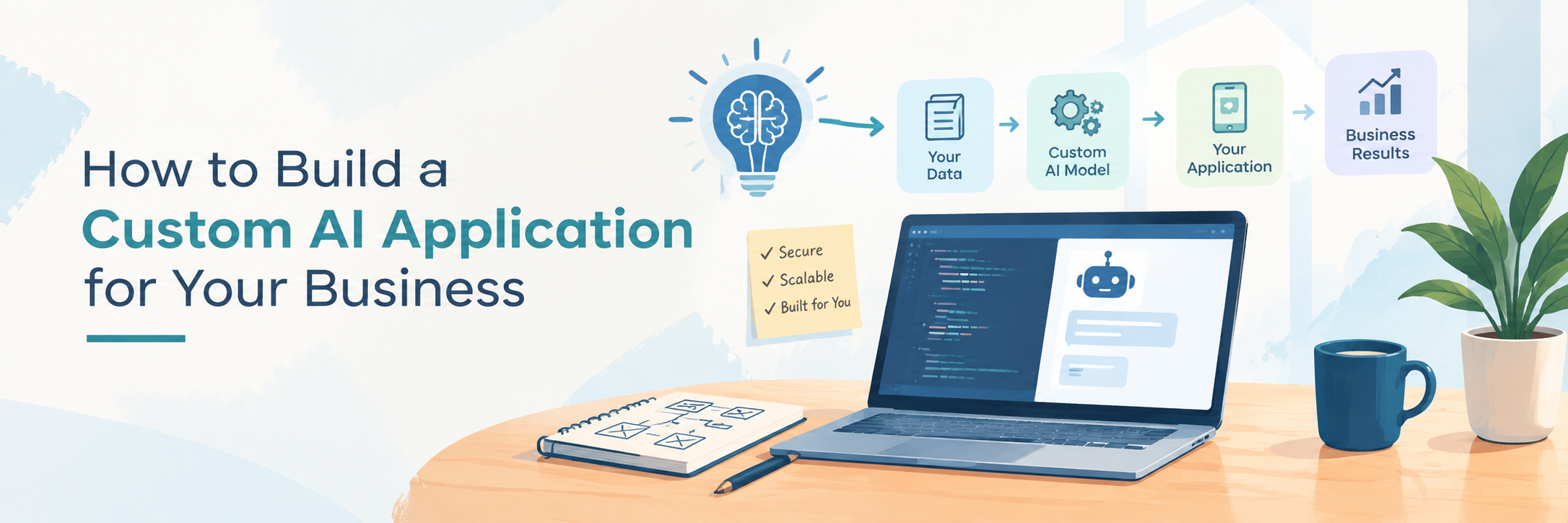


An AI application can generate impressive answers, predict customer behaviour, automate repetitive tasks or help employees make faster decisions. But a successful business application must do something more important: solve a real problem reliably, within the systems and processes your business already uses.
Imagine a company that receives thousands of customer enquiries every month. A generic AI chatbot might answer common questions. A custom AI application could go further: understand the enquiry, retrieve relevant information from company systems, create a support ticket, recommend the next action and route complex cases to the right employee.
The difference is not simply the AI model. It is the way the entire application is designed around the business outcome.
This is why custom AI application development should begin with a business problem—not a technology trend.
1. Start With the Business Problem, Not the AI Model
The first question should never be, “Which AI model should we use?”
Start by identifying the process that needs to improve.
Is your business trying to reduce manual data entry? Help employees find information across multiple systems? Improve demand forecasting? Automate document processing? Introduce intelligent features into an existing product?
A useful starting point is to establish three things:
-
The current problem: What is inefficient, expensive, slow or difficult today?
-
The desired outcome: What should improve, and how will you measure it?
-
The application boundary: Which decisions can AI support, and which actions require human approval?
For example, a logistics company may want to reduce the time employees spend reviewing delivery exceptions. The objective is not simply to introduce AI. It is to help employees identify exceptions, understand their causes and prioritise corrective action.
That distinction determines the features, data, architecture and evaluation criteria required.
Practical tip: Define a measurable baseline before development begins. Depending on the use case, this could include processing time, error rates, manual interventions, resolution time or cost per transaction.
Without a baseline, even a technically impressive application can be difficult to evaluate commercially.
2. Assess Your Data Before Choosing the Technology
AI applications depend on data, but having large amounts of data does not automatically make a business AI-ready.
The data may be scattered across spreadsheets, databases, CRM platforms, ERP systems, documents, emails or legacy applications. Some may be incomplete, duplicated, outdated or inconsistent.
Before development, assess:
-
Where the required data resides.
-
Whether the data is accessible and sufficiently reliable.
-
How it can be connected to the application.
-
Whether the organisation has appropriate rights and permissions to use it.
-
What sensitive or personal information it contains.
-
How frequently the data changes and must be refreshed.
The assessment also helps determine whether the application needs historical datasets, live system access, structured records or unstructured information such as PDFs and documents.
Consider an AI application designed to answer questions about internal company policies. If the source documents are outdated or contradictory, selecting a more powerful model will not automatically resolve the underlying problem.
Data preparation, retrieval and validation may be more important than model complexity.
The objective is to make the right information available to the application in a usable, controlled and maintainable form.
3. Choose the Right AI Approach
Not every business problem requires the same type of AI. The appropriate approach depends on the task, available data, accuracy requirements, operating cost and expected behaviour.
|
Business requirement
|
Possible technical approach
|
|
Predict sales or demand
|
Machine learning and predictive analytics
|
|
Extract information from documents
|
OCR, document processing and AI models
|
|
Answer questions using internal knowledge
|
Generative AI with retrieval-augmented generation (RAG)
|
|
Classify enquiries or transactions
|
Classification models or AI APIs
|
|
Automate a multi-step business workflow
|
AI orchestration, tools and controlled workflow logic
|
|
Introduce intelligence into an existing product
|
AI APIs or embedded model services
|
These are starting points, not fixed rules. A solution may combine several approaches.
For example, an application might use a conventional rules engine to validate transactions, a machine learning model to identify anomalies and a generative AI component to explain the results to an employee.
Combining AI with conventional software logic can make a system more predictable than asking a single model to handle every step.
Build a model, use an API or adapt an existing model?
Businesses generally have three broad options:
-
Use an existing AI API: Often suitable when a proven model already supports the required capability.
-
Adapt an existing model: Consider retrieval, prompt engineering or fine-tuning when the application needs domain-specific behaviour or information.
-
Develop or train a specialised model: May be appropriate when the problem requires capabilities that existing models cannot adequately deliver.
Custom AI development does not necessarily mean building a foundation model from scratch. In many projects, the greater engineering effort lies in integrating models with business data, application logic and operational workflows.
Model selection should consider output quality, latency, cost, deployment options, data handling and the ability to change models later. Microsoft’s AI architecture guidance similarly recommends evaluating models against workload requirements rather than selecting them based on popularity alone.
4. Design the Application Architecture
Once the business requirements, data and AI approach are clear, the next step is designing how the components will work together.
A typical custom AI application may include:
-
User interface: Web application, mobile application or internal dashboard.
-
Backend services: Business rules, authentication, authorisation and workflow management.
-
AI integration layer: Model APIs, inference services, prompts and orchestration.
-
Data layer: Databases, document stores, search systems and relevant business records.
-
Integration layer: APIs connecting the application to CRM, ERP, payment, support or other platforms.
-
Monitoring and control: Logging, performance measurement, access controls and operational alerts.
The architecture should reflect the actual use case. A simple classification application may not require complex orchestration, while a multi-step AI workflow may need separate components for retrieval, decision support, validation and action execution.
A good architecture also avoids making the entire application dependent on one model provider or one tightly coupled component.
Where practical, model access should be separated from core business logic. This can make it easier to test alternative models, manage costs and introduce new capabilities without rebuilding the whole application.
The objective is not to create the most sophisticated architecture.
It is to create an architecture that meets today's requirements and can evolve as the business grows.
5. Develop the Application Around Real Workflows
Development is where the proposed solution becomes a working product.
The team builds the interface, backend logic, data connections, AI integration and business workflows. It also determines how the application responds when the AI produces an uncertain, incomplete or unusable result.
This last point is critical.
Suppose an AI application extracts information from purchase orders. A dependable implementation should not simply accept every generated result. It can validate required fields, check values against business rules, flag inconsistencies and route uncertain cases for human review.
Likewise, an AI assistant that recommends actions should not automatically receive permission to perform every action it can describe.
Actions such as issuing refunds, approving transactions or modifying important records may require explicit authorisation and confirmation.
A strong implementation separates what the model suggests from what the application is permitted to execute.
This is where software engineering makes a substantial difference. AI capabilities need to be connected to reliable application logic, controlled permissions and clearly defined business processes.
6. Integrate AI With Existing Business Systems
A standalone AI demonstration can be useful, but many businesses need AI to operate within their existing technology environment.
An application may need to retrieve customer information from a CRM, read inventory from an ERP, access approved documents or send results to a workflow management system.
Integration introduces several practical considerations:
-
API compatibility and authentication.
-
Data mapping and format conversion.
-
Access permissions across systems.
-
Rate limits and response delays.
-
Handling of failed requests and unavailable services.
-
Duplicate transactions and retry behaviour.
-
Consistency between AI-generated results and business records.
For example, an AI sales assistant that recommends products based on outdated inventory information can create problems even if its responses are well written.
The quality of the overall application depends on the quality of the connections between its components.
That is why AI integration should be planned as part of the original solution—not treated as a final add-on.
7. Test the Application Before Production
Testing an AI application requires more than checking whether the interface works or whether the model produces a plausible response.
The application must be evaluated against real business scenarios and measurable acceptance criteria.
Important testing areas include:
-
Functional testing: Do application workflows behave as expected?
-
AI quality testing: Are outputs sufficiently accurate, relevant and consistent?
-
Integration testing: Do connected systems exchange data correctly?
-
Security testing: Are access controls, APIs and application components appropriately protected?
-
Performance testing: Can the application handle expected traffic and response-time requirements?
-
Failure testing: What happens when the model, API or data source is unavailable?
-
User acceptance testing: Can intended users complete their actual tasks successfully?
For generative AI, testing should include misleading inputs, ambiguous questions, unsupported requests and attempts to obtain information the user should not access.
Where outputs influence important decisions, the application may also need confidence thresholds, human review or additional verification steps.
A successful demonstration proves that a feature can work. Structured testing provides evidence about whether it is dependable enough for its intended use.
8. Deploy, Monitor and Improve
Production deployment is not the finish line. It is the beginning of operating the application under real conditions.
User behaviour, data patterns, traffic volumes and business requirements can change. Model providers may release new versions, and an approach that worked well during a prototype may perform differently at scale.
A production-ready solution therefore needs an operating plan covering:
-
Application and model performance.
-
Response times and availability.
-
Usage and operating costs.
-
Output quality and error patterns.
-
Security events and access activity.
-
Model or prompt changes.
-
Feedback, issue resolution and ongoing improvement.
For machine learning systems, changes in input data can affect predictive performance. For generative AI, changes to models, prompts or retrieved information can alter responses. Monitoring and repeatable evaluation help teams identify such changes.
Cloud architecture guidance from Google also treats validation, evaluation, deployment and monitoring as connected parts of the AI lifecycle.
The goal is to make AI a maintainable business capability—not a one-time technology experiment.
What Does Custom AI Application Development Actually Require?
The effort depends on the use case, data readiness, integration complexity, quality requirements and deployment environment.
A focused AI feature using an existing API may be relatively straightforward. An enterprise application involving multiple systems, specialised models, complex workflows and stringent reliability requirements will demand more extensive engineering.
Before committing to a timeline or budget, clarify the expected scope, data dependencies, integrations, evaluation criteria and production requirements.
A practical engagement may begin with discovery and a proof of concept, progress into a validated pilot, and then expand into a production application. This staged approach helps businesses test assumptions before committing to a larger implementation.
The important distinction is that a proof of concept demonstrates feasibility; a production application must also address security, reliability, integration, maintainability and operational support.
Turning Your AI Idea Into a Working Business Application
The real value of custom AI application development lies in connecting intelligence to a business process in a way that is useful, measurable and sustainable.
That requires more than choosing a model. It requires business analysis, data assessment, architecture, software development, integration, testing and production engineering.
For businesses, the right technology partner can turn an initial idea into a practical implementation plan. For agencies, consultants and technology providers, an experienced engineering team can extend delivery capacity when a client project requires AI application development and integration.
Zillion IT Solutions brings more than two decades of software development experience to modern application engineering, including AI-enabled solutions, integrations and digital products. The focus is on translating business requirements into software that can work within real operating environments.
Planning an AI application for your business?
Start by identifying the problem you need to solve. Zillion can help assess the use case, define the technical approach and develop a practical path from concept to production.