
The agent may have understood the code correctly and still recommended the wrong change.
This is not simply a coding error. It is a context problem.
The information needed to make a safe decision may exist in an old ticket, a pull request, a customer agreement, an incident report or the knowledge of an experienced employee.
Consequently, effective AI-assisted modernisation must consider the wider application environment—not just the source repository.
Before modifying a component, teams should establish what it does, which systems depend on it, what business rules govern it and what evidence supports changing its behaviour.
A Practical Approach to AI-Assisted Legacy Modernisation
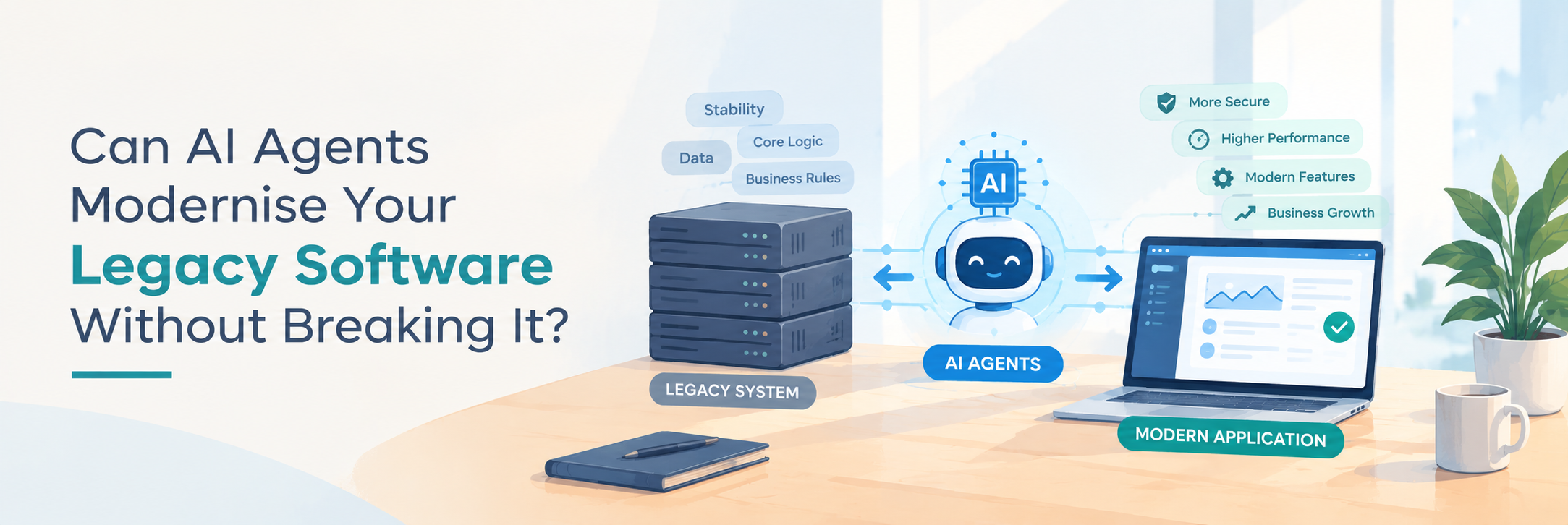
The most effective approach is not to give an AI agent an entire legacy application and ask it to modernise everything.
It is to break the work into manageable, verifiable stages.
Step 1: Assess the Existing Application
Start with an engineering assessment of the current system.
Identify the technology stack, application modules, dependencies, integrations, known issues, maintenance backlog and business-critical functions. Establish which components are stable, which are becoming difficult to maintain and which present the greatest operational risk.
AI agents can assist with repository analysis and documentation discovery, while engineers validate the findings against the actual operating environment.
Deliverable: A prioritised application assessment and modernisation roadmap.
Step 2: Map Dependencies and Business Rules
Before changing code, investigate how the relevant components interact.
Trace API calls, database dependencies, configuration settings and external integrations. Review available change history, incident records and existing documentation to identify unusual behaviour that may have a business justification.
Flag unresolved assumptions instead of allowing the agent to treat missing information as permission to simplify the code.
Deliverable: A dependency map, documented constraints and a list of questions requiring business or engineering clarification.
Step 3: Establish a Reliable Testing Baseline
Determine how the application currently behaves before introducing changes.
Review existing tests and identify gaps around critical workflows. Where appropriate, create characterization tests that capture observed behaviour, then have engineers confirm that the behaviour is expected.
This distinction matters: a test can record what the application does without proving that it should continue doing it.
Deliverable: A baseline test suite and acceptance criteria for the proposed change.
Step 4: Make Small, Controlled Changes
Select a specific maintenance problem rather than attempting a broad rewrite.
Ask the agent to propose a narrowly scoped change, explain its assumptions and identify the expected impact. Keep unrelated refactoring separate, review the resulting code and run the relevant tests.
If the task involves financial calculations, access controls, critical integrations or destructive database operations, apply stronger approval and validation requirements.
Deliverable: A focused, reviewable change with documented scope and test results.
Step 5: Validate Before Release
Passing tests is necessary, but it may not be sufficient.
Check for unintended changes to business behaviour, security weaknesses, integration failures and performance regressions. Use staging environments, controlled rollouts and rollback plans where appropriate.
After deployment, monitor application errors and relevant business metrics to identify issues that may not have appeared during testing.
Deliverable: A validated release with monitoring and recovery procedures.
This staged approach keeps AI productive without treating its output as inherently trustworthy. GitHub's guidance on reviewing AI-generated code similarly emphasises functional checks, testing and human review before accepting changes.
Which Modernisation Tasks Should You Automate First?
Not every legacy maintenance activity needs the same level of autonomy.
|
Task
|
Suggested approach
|
|
Code explanation and dependency discovery
|
AI-assisted investigation
|
|
Documentation and test generation
|
AI-assisted, followed by review
|
|
Formatting and isolated static-analysis fixes
|
Limited automation with validation
|
|
Refactoring well-understood modules
|
Agent-assisted changes with regression testing
|
|
Database migrations and major architectural changes
|
Engineering-led planning and controlled execution
|
|
Billing, authentication and critical business rules
|
High scrutiny, explicit human approval and comprehensive testing
|
|
Production deployment and destructive operations
|
Strict permissions, release controls and recovery planning
|
The principle is straightforward: the greater the uncertainty and potential impact, the tighter the controls should be.
An agent that can read a repository does not automatically need permission to modify production data or deploy code. Access should be limited to what the task requires, and consequential actions should have appropriate approval mechanisms.
Modernise, Refactor or Rebuild?
AI-assisted maintenance also raises an important business decision: should an organisation improve its existing application or replace it?
Modernisation is often appropriate when the core application remains valuable but needs better maintainability, updated dependencies, improved integrations or selected architectural improvements.
Refactoring can help when the software's structure makes changes unnecessarily difficult, provided the intended behaviour is understood and protected.
A larger rebuild may be justified when the architecture cannot reasonably support essential business requirements, critical dependencies are no longer viable, or the cost and risk of continued maintenance outweigh the alternatives.
AI does not eliminate the need for this assessment. It may reduce the effort required to understand the current system, but the decision should still consider business continuity, migration complexity, integration requirements, future scalability and total cost of ownership.
The objective is not to modernise for the sake of using AI. It is to select the approach that creates the most sustainable business outcome.
Where a Software Engineering Partner Adds Value
AI tools can accelerate investigation and implementation, but businesses still need a disciplined process for turning recommendations into dependable software.
That includes understanding the existing application, validating business requirements, designing the target architecture, managing dependencies, integrating systems, testing changes and planning deployment.
For organisations with limited internal engineering capacity, an experienced development partner can help assess where AI-assisted maintenance is appropriate and where conventional engineering methods remain the better choice.
The same applies to technology providers and agencies managing client relationships: an engineering partner can extend delivery capacity for legacy application assessment, modernisation, integration and testing without requiring every capability to be built in-house.
The value lies not in claiming that AI can replace an engineering team, but in combining AI-assisted productivity with the technical judgment needed to deliver reliable changes.
The Future of Legacy Software Is Not a Blind Rewrite
AI agents are creating new possibilities for maintaining software that businesses once considered too difficult, expensive or risky to change.
They can help developers navigate unfamiliar code, investigate dependencies, generate tests and address well-defined maintenance tasks. Used carefully, these capabilities can make years of accumulated technical debt more manageable.
But the most important work often happens before the code changes: discovering why the application behaves as it does, identifying what must remain stable and determining how the proposed improvement can be verified.
The goal is not to let AI change legacy software faster. It is to make software improvement safer, more deliberate and more sustainable.
Planning to Modernise a Legacy Application?
Zillion IT Solutions brings more than two decades of software development experience to application engineering, modernisation and integration projects.
Whether you need to improve an existing business application, address technical debt, modernise selected components or assess where AI-assisted engineering can add value, the starting point is understanding your current system and defining a practical roadmap.
Talk to Zillion IT Solutions about modernising your application with a clear engineering strategy, controlled implementation and testing designed around your business requirements.